Showing posts with label Jaxon Filtration. Show all posts

Friday, April 4, 2014

Fuller's Earth Systems

I found this great Filtration System that comes in a variety of sizes and types. They are available for in-plant stationary applications as well as module systems. They come available as stand-alone systems or as modules for integration into existing equipment.
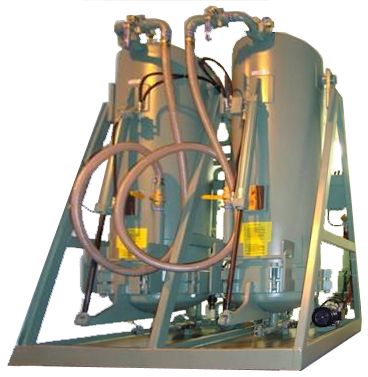
Single bulk filter systems are available with earth capacities of 250, 500, 850, 1000 and 2000 pounds. Typically two or more filters of identical capacity will compromise a system. This allows optimum usage of the clay and change-out of the charge in one filter while the other is still in use.
Floor models are available for transformer manufacturing and repair facilities. Portable systems are available on open trailer, tarp-sided trailers, swing-door trailers, hard-sided hitch/tag trailers and semi-trailers.
Each clay filter is rigidly mounted in a frame that allows for dumping of the spent clay. A vacuum fill port is provided for connection to an external. Vacuum source for filling (a locally mounted vacuum system is available as an option).
Pressure gauges are provided on both inlet and outlet lines to the filter and a flow-sight indicator is provided to monitor flow conditions and purified oil color. In addition, a sight-glass is provided on the filter to visually monitor the condition of the clay. Whenever the vessel is filled with fresh clay, the filter is subjected to vacuum to evacuate all trapped air prior to flooding with oil.
The most efficient use of the clay is obtained by running the towers in parallel with the lead tower as the roughing filter and the second tower performing the polishing. When the clay in the lead filter is spent, it is changed and the series flow reversed to make the freshly charged tower the polishing unit and the former polishing unit the roughing filter.

Thursday, March 6, 2014

Molecular Sieve

Description:

4A molecular sieve is primarily used for removing moisture from liquefied gaseous materials. Advantages are consistent adsorption speed, higher contamination resistance, stronger crushing increasing cyclic times for extended product life.
4A molecular sieve has a pore size of 4A or 4 angstrom. Any molecule larger than 4A will not be able to be adsorbed. 4 Angstroms are the sodium forms of the Type A crystal structure. The sequence rate of adsorption is argon, krypton, xenon, ammonia, carbon monoxide, C2H4, C2H2, CH3OH, C2H5OH, CH3CN2, CS2, CH3CL, CH3Br, and carbon dioxide.
The advantages of our high quality 4A mole sieve are consistent adsorption speed, and higher contamination resistance, stronger crushing increasing cyclic times which provide an extended product life. 4A Molecular Sieve is primarily for removing moisture from liquefied and gaseous materials.

Applicaitons:

It has become one of the most reliable desiccants for a variety of applications including:
  • Refrigerant Drying
  • Moisture removal in PU Plastic or Paint
  • Natural Gas Drying
  • Drying Cracked Gas
  • Static drying of insulating glass units, whether air filled or gas-filled.
  • Dehydration of highly polar compounds, such as methanol and ethanol.
  • Dehydration of unsaturated hydrocarbons (e.g. ethylene, propylene, butadien).

Wednesday, November 13, 2013

Attapulgite Clay Storage


I've been running across a lot of information on attapulgite clay and the proper storage of said clay. Clays are hydroscopic, so it is important to store them in a climate controlled environment.  Clay should be packaged in a way that ensures the clay does not absorb moisture during transit or during short storage periods.

For on-site inventory, it's recommended to limit storage to 6 months for standard products and three months for specialty low moisture clays. Also try not to freeze and thaw the clay.

Care should be taken not to store the clay next to chemicals giving off evaporating compounds, as the clay readily absorbs certain vapors.

Thursday, August 29, 2013

Fullers Earth Estimation:

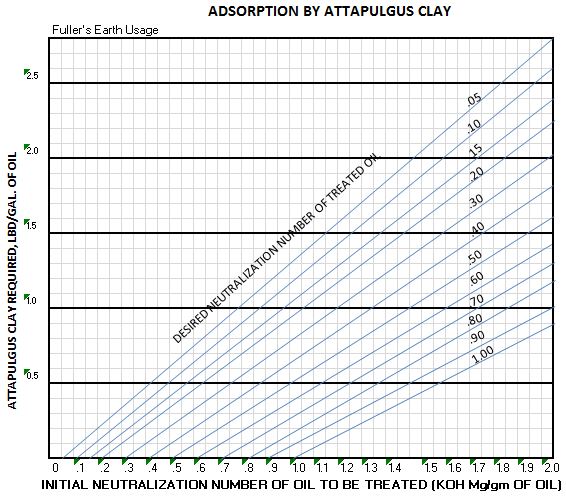
So how much? That's always the question they ask. But are you not sure how much Fullers Earth you need? We found this chart that estimates the amount of fullers earth by weight that is required per gallon of oil to be processed.

This handy chart provides a means of estimating the amount of fullers earth you need, by weight, all you need to know is the amount of oil to be processed!


What is Fuller’s Earth?

Fullers Earth is Activated Clay, commonly used to remove surfactants and additives from fuel oils including jet fuel, kerosene, and diesel. It also removes products of oxidation and acids from hydraulic and lube oils. Bulk Fuller's Earth can be used at airports, in refineries, transformer repair shops, and other industries.


Monday, July 8, 2013

Fuller’s Earth 30/60 Clarification Aid:

Fuller's Earth 30/60 Clarification Aid is a granular aluminosilicate used in packed bed applications for the clarification of liquids. This material is mined and processed to provide maximum surface area and chemical adsorptivity.

Performance, Benefits, and Features

  • This has excellent particle strength resists attrition, lowers dust, and prevents plugging
  • Saves money with low bulk density by filling towers with less weight
  • Consistent particle size, load after load
  • Quality Assurance Program ensures performance standards
  • All materials are high-quality, LVM grades manufactured to precise size specifications
  • LVM granules offer the highest chemical activity available

Suggested Processing Applications

Fullers Earth 30/60 Clarification Aid is used in applications from small cartridges to large towers, to remove unwanted contaminants in a variety of fixed bed.
 
Applications include:
  • Dry cleaning solvents.
  • Removal of surfactants and water from jet fuel.
  • Dielectric oil used to insulate commercial transformers.
  • Industrial processing chemicals and solvents.

For more information contact Jaxon Filtration:
Telephone:
Toll Free:
706-675-3996 
888-780-3568
Fax:
706-675-3787
e-Mail:
sales@jaxonfiltration.com

Tuesday, June 11, 2013

Selexsorb - alumina-based adsorbent material

Selexorb is a promoted alumina-based adsorbent material formulated to remove trace contaminants for refinery production.

Uses and features for Selexorb:
  • Highly efficient at removing many contaminants from olefin containing streams
  • Complete system solutions for treatment of off-gas streams from catalytic crackers and acetylene producing units
  • Long lifetime, easy operation, and physical hardness and durability
  • Does not release minerals that can promote sludge and gels within the reservoir.
Selexorb Applications:
  • Used for filtering synthetic oils.
  • Used in various aspects of olefin production and refineries.
  • Purifies Olefins, Aliphatics, gases, feed stocks for Alkylation, MTBE, TAME, and BTX units.
  • Removes COS, H2S, CS2, CO2, H2O, NH3, Mercaptans, Sulfides, Disulfides, Thiophenes, Oxygenates, (Alcohols, Aldehyhdes, Ketones, etc.), Amines, Amides, Nitriles, Organosilicates and Arsine.
 

Tuesday, April 30, 2013

Fuller's Earth for Fuel Treatment

Everyone knows its a bad idea to have dirt or water in your fuel. This is especially true for aircraft fuel systems. Not only is it much more inconvenient to pull your jet over to the side of the road, but because of the elevation fuel line freeze-up is more likley.
 
However dirt and grime are not the only threats to an airplane. If bacteria begins to grow in the fuel system, which is more than possible with the presense of H2O, corrosion and errors in the signals for the fuel guages can cause serious issues.
 
So where does this contamination come from? Here are a few common culprits:
  • Some come from the refinary durring treatment
  • Others come from the pipelines, transport trucks, ships and barges.
  • Maintenance materials like soaps, detergents, rust prevenatives, etc.

Want to know more? Check out this great article from Jaxon Filtration


Not only do they explain the problem in grave detail but they also discuss the solution!!

Fuller's Earth for Fuel Treatment