Showing posts with label wastewater. Show all posts

Wednesday, February 14, 2018

Filter Press Pumps that can handle the slurry

Filter Press Diaphragm Pumps


Filter Press Diaphragm Pumps
Diaphragm pump mounted to filter press manifold and catwalk.

Air operated diaphragm pumps are used with filter presses to pump sludge from the bottom of the sludge holding tank into the filter press.  These pumps are ideal because they can handle the slurry which is generally about the consistency of a milkshake. 

The diaphragm pump usually starts out slowly and gradually ramps up.  Once the pump starts to slow back down, (30-60 seconds between thrusts), it is usually an indicator that the filter press is full.  At this point the feed pump should be turned off and the valves on the filter press closed as the operator prepares to operate the air-blow-down process.

The diaphragm pump can be manually turned up or an Automatic Pump Control system may be added.  This starts the pump at 25 psi, then moves up to 50, 75 and finally 100 psi which is standard operating pressure for the pump.

Met-Chem provides diaphragm pumps in the following sizes:  1”, 1.5”, 2” and 3”.  Material of construction ranges from cast iron, aluminum, polypro or stainless steel.

With the purchase of a new Met-Chem filter press Met-Chem can mount your air operated diaphragm pump to the legs of your filter press.  This option also includes a flex hose that connects the outlet of the diaphragm pump to the center feed pipe, an air filter, a regulator, and an oiler.   We can also provide a mounted diaphragm pump for your existing press. 

for more information on Filter Press Pumps visit Met Chem

Wednesday, March 19, 2014

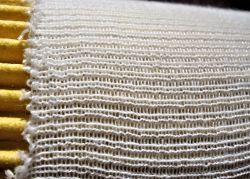
Knit tubing

Some application require more than a standard filter. Some times there is too much "stuff" to be filtered out, and a standard filter clogs too easily. We've found that is when knit tubing can really come in handy. It excels at removing the big particles. 

How to use it?

  • Well it could be as easy as tying a piece of kit tubing over top your existing filter. When it gets clogged just remove, clean, and return. This can dramatically increase the life of your more expensive filter.
  • Run the solution through the knit tubing, think a nylon on the end of the washing machine hose. Fill it up and throw it away!
  • Need your solution to be a uniform consistency? Use knitted tubing to filter out clumps and chunks.  
Those are just a few ideas! 

Monday, March 17, 2014

About Lakeside Water Treatment

Reliable & Innovative Provider of Commercial and Industrial Water Treatment Systems

Commercial and Industrial Water Treatment EquipmentThey have established themselves as a reliable and innovative provider of commercial and industrial water treatment equipment throughout the world.

Their product offerings include water softeners, dealkalizers, demineralizers, filters, reverse osmosis, and condensate polishers. They incorporate other products such as forced air decarbonators, bulk brine silos, regeneration stations, chemical feed systems and neutralization systems, to provide a complete sole source water treatment package to the end user customer. Their technically trained sales and engineering staff, not only provide you with products, but also provide you with sizing and selection assistance in order to make sure that the equipment selected is the best choice for the project.


Lakeside Water Treatment Inc. was founded in 1990 by experienced water treatment professionals. They average over thirty years of industry experience per employee. At the same time the latest in CAD and computer networking technology is being utilized. Their engineering staff has evolved from the water treatment industry bringing together at one facility, the necessary process, controls and manufacturing expertise to produce the type of quality built equipment that you can trust to perform.

They are located on the northwest side of Milwaukee. Customers are welcome, at any time, to tour their facility and learn more about how Lakeside can assist their efforts.

Monday, March 10, 2014

Filter Press FAQs


1.         How do I know when the filter press is full?  The diaphragm pump will get to 30 second to one minute intervals between thrusts, indicating that pressure has increased due to solids building up inside the press cavities.  This is your signal that the press is full.
 
3.         What is involved in routine filter press maintenance?  Cloth cleaning, dumping, check hoses and connections.
 
4.         When do the cloths need to be cleaned or replaced?  The filter cake will begin to become wet, slimy and not as dry.  This is your indicator that the cloths need to be cleaned.  (see number 5 for cleaning info).  If you have already cleaned your cloths and your process has not changed but you are still getting slimy filter cake, it may be time to replace your cloths.  Cloth life varies from installation to installation and depends on such variables as frequency of cycles, proper cleaning and maintenance and the type of sludge that is generated.  Generally speaking for most installations cloths can last up to 6 months at the most.
 
5.          Will I need to replace the plates?  Plates generally last years unless they become cracked, broken or warped.  It is good practice to examine the plates during press cleaning and dumping.
 
6.         Can I expand my press for larger loading capacity?  Expansion depends on a couple of factors.  First, if your press is already expandable, meaning you’re your press has a distance piece for expansion to a larger capacity, all you need to do is unbolt the distance piece and add additional plates in the 1-3 button sequence taking care that you add plates in even numbers.  However, if you have a Met-Chem press or your press has notched and bolted sidebars, then  it can also be expanded by removing the sidebars and replacing them with longer sidebars and installing additional plates.  Please note that when adding plates, you must be sure to add them in the 1-3 button sequence in order to provide proper drainage.
 
7.         Can I add more plates to my current press?  You may be able to add a couple of plates without expanding your sidebars if your press is not already expandable but care must be taken to ensure that you have adequate cleaning room when dumping the press and cleaning the cloths.
 
8.         How long is the cycle time?  Cycle time is dependent on solids loading and can take anywhere from 2-4 hours on average.  (Closer to four hours for typical metal hydroxide waste.)
 
9.         What can I do to ensure the driest possible filter cake?  Be sure cloths are cleaned as needed and the air blow-down system is run for a full cycle.  You may also wish to add a sludge dryer to your system.  A dryer accepts filter press cake and dries it further to provide up to a 4:1 sludge reduction.  (for more information on sludge dryers click the following link:  www.metchem.com/sludge_dryer.htm
 

Monday, February 24, 2014

Reverse Osmosis System

Let's talk a little about Reverse Osmosis Systems

Standard Reverse Osmosis System Features

  • Expandability – modular systems can be expanded to meet future requirements.
  • Compact size – systems can be adapted to almost any plant layout.
  • Liquid-filled pressure gauges – liquid filled gauges assure pulse-free readings and long gauge life.
  • Line-mounted flow meters – offer consistent accuracy and corrosion- free performance.
  • Computerized system design – accurately projects system performance based on each application’s requirements and operation conditions.
  • Rotary vane pumps – the industry standard for trouble-free service, efficiency and corrosion resistance.
  • Pressure relief valves – protect rotary vane pumps from over-pressurization.
  • Control systems – adaptable to suit customer specifications.
  • Premium control option – includes microprocessor-based controller for increased reliability and process control capabilities.
  • Needle valves – included for precise flow and pressure control.
  • Convenient layout – all gauges, meters and controls are mounted next to the control panel for ease of operation.
  • Feedwater solenoid valve – shuts off feedwater when system is not operating.
  • Low-pressure switch – protects the pump from cavitation and damage caused by inadequate inlet pressure.

Optional Reverse Osmosis System Features

  • Fiberglass frame – assembled with stainless steel hardware for total corrosion controls.
  • Stainless multistage centrifugal pumps and product pumps.
  • Spiral wound, thin film composite membranes – provide superior salt rejection and product flow at low operating pressures and offer excellent membrane lift.
  • Cartridge pre-filter – all polypropylene for corrosion control; five-micron filter included.
  • Control panel – NEMA 4 control panels include product tank level control, optional product quality monitor, fuses, motor controls, switches and system logic.


Tuesday, November 5, 2013

how to rinse with less water!


We all know it's common to find three out of four tanks devoted to rinsing.  This  step is necessary to:
  • Stop any action of a chemical solution.
  • Prevent the contamination of a subsequent process.
  • Prevent chemical staining of the work.
Good rinsing with small amounts of water has always the goal, but in today's regulation dominated world.  Reducing water lessens the load on waste treatment systems and makes recovery more practical. 

The purpose of counter-flowing rinses is just to conserve water.  By increasing from one to two rinses, you can same 20 to 100 times the water.

If you want to learn more about Rinsing with Less Water read this article >>

Monday, October 28, 2013

Filter Resources Page

Below are some links to common filters:
Absolute Micro-Glass
Activated Alumina  
Activated Charcoal & Process Water Clarifier
Aqua-Pro
Auxiliary Equipment
Belt Filters 
Bentoniete Clay
Bleaching Clays
Bulk Columns: 
Centrifuge Bags/Liners
Clarifiers
Condenser
Control Panels
Custom Filters 
Diatomaceous Earth
Dust Bags 
Evaporative Tank
Excelsior
Filter Leaf Bags  
Filter Media
Filter Paper & Discs 
Filter Press Cloths 
Filter Presses
Filter Tester
Filtration 
Fullers Earth
Fullers Earth Amount Estimation Table
Heated Tank Systems
Industrial Water
Ion Exchange
Liquid Filters  
Liquid Filtration
Molecular Sieve 
Nominal Microns
Parker Finite Filters
Pleated Paper
Portable Filter Systems
R/O Membrane
Replacement Filter Bags 
Reverse Osmosis Systems
RVM Clay
Selexsorb Acid
Selexsorb Filter Cartridges and Systems 
Semi-Conductor
Simplex Sampler
Sludge Bags
Sludge Dryers
Spin on Filters
Steam Filters
Sterile Air Filters
Sterile Gas Filters
Sulfur Guard Filters
Tank Vent Filters
Trans Dri 
Treatment Systems
Turn-key Systems
Vapor Phase 4x8 Pellets
Water Condensate Polishing Systems
Water Dealkalizer Systems
Water Demineralizer Systems
Water Filtration Systems
Water Softener Systems


Monday, September 16, 2013

Lakeside Water Treatment

Lakeside Water Treatment Inc. is a manufacturer of commercial and industrial water treatment equipment. Lakeside offers pre-engineered and custom designed water softeners, dealkalizers, demineralizers, deionizers, condensate polishers, chemical feed systems, instrumentation, reverse osmosis systems, and pressure filters.

Reliable & Innovative Provider of Commercial and Industrial Water Treatment Systems

Centrally located in Milwaukee, Wisconsin, Lakeside Water Treatment has established itself as a reliable and innovative provider of commercial and industrial water treatment equipment throughout the world.


Tuesday, September 10, 2013

Sludge Blowdown System

Sludge Blowdown System:

This tool is designed to monitor the time the Clarifier is in use. For example; when the pump that feeds the waste stream leading into the Clarifier, is turned on the timer is timing. After the predetermined time has elapsed, the controller will automatically open the discharge valve and activate the discharge pump to the sludge thickening tank, and then automatically turn off the pump and close the valve. The time elapsed is based on the clarifier, the waste water, and the sludge.

System includes: sludge valve, air valve and control panel with timers and cast iron diaphragm pump.

Click below to view a video of the process:
http://metchem.com/Air-Blow%20down%20Stage.avi