Showing posts with label Filter Media. Show all posts

Thursday, September 25, 2014

Met Chem Inc.

New filter presses, used filter presses, and custom filter presses for all your industrial filter press needs
Met-Chem was established in 1956 as a manufacturer’s representative for liquid filtration equipment with an in-house sewing department to manufacture replacement filter bags, cloths and media. 

Over the years, Met-Chem has acquired complimentary companies to add to our group of process equipment and replacement parts suppliers.  Met-Chem’s equipment manufacturing began with filter presses and clarifiers and gradually grew to include sludge dryers and complete waste treatment systems and component parts.

Their equipment has been used in a variety of industries from plating and metal finishing to chemical, food and beverage processing to name a few.  Met-Chem features heavy duty steel construction.  Using modern manufacturing processes, the equipment and systems can be tailored to your specific space and system needs. 

Call a Met-Chem representative for any of your filtration or wastewater treatment needs; Phone: 216-881-7900 or e-mail: info@metchem.com

Tuesday, April 1, 2014

Why you need Culinary Steam

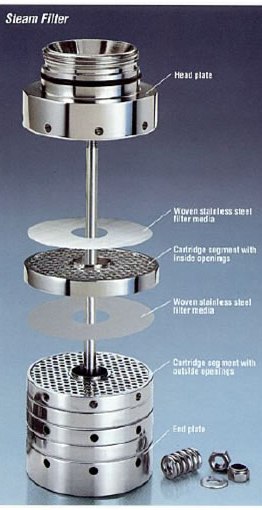
This is some information from Micropure Filtration regarding their Culinary Steam filters 

Culinary Steam filters are an essential part of any processing facility. They will help protect equipment and process filters from damage. They can remove debris and scale that are present in steam lines and systems. By ensuring quality steam, you can reduce your downtime and increase your processing efficiency.
Culinary rated Steam Filters are filters remove 95% of particulates 2 microns or lager. However with Micropure's absolute rated filter media it will be removing 99+% of particulates at your chosen micron level. Micropure offers media in 1, 2, 3, and 5 micron ratings to fit your exact requirement. By using their Culinary Steam filter, your steam used in mixing, agitating or cooking will be free from contaminates that could possibly spoil the appearance, smell, or taste of your final product.

More than the media:

A Stainless Steel housing and a segmented element design support the filter media. This design helps maintain its integrity and absolute rating under conditions that cause conventional sintered media to disintegrate and lose effectiveness. Micropure Filter media can be easily cleaned or back flushed in place removing the need for acid cleaning or frequent disposals. Their segmented design allows you to only have to replace the filter media instead or having to replace the entire element. This will offer you a substantial cost savings compared to a typical sintered or pleated element.

Wednesday, March 19, 2014

Knit tubing

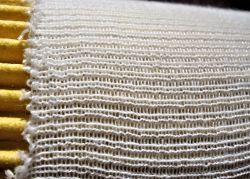
Some application require more than a standard filter. Some times there is too much "stuff" to be filtered out, and a standard filter clogs too easily. We've found that is when knit tubing can really come in handy. It excels at removing the big particles. 

How to use it?

  • Well it could be as easy as tying a piece of kit tubing over top your existing filter. When it gets clogged just remove, clean, and return. This can dramatically increase the life of your more expensive filter.
  • Run the solution through the knit tubing, think a nylon on the end of the washing machine hose. Fill it up and throw it away!
  • Need your solution to be a uniform consistency? Use knitted tubing to filter out clumps and chunks.  
Those are just a few ideas! 

Monday, March 10, 2014

Filter Press FAQs


1.         How do I know when the filter press is full?  The diaphragm pump will get to 30 second to one minute intervals between thrusts, indicating that pressure has increased due to solids building up inside the press cavities.  This is your signal that the press is full.
 
3.         What is involved in routine filter press maintenance?  Cloth cleaning, dumping, check hoses and connections.
 
4.         When do the cloths need to be cleaned or replaced?  The filter cake will begin to become wet, slimy and not as dry.  This is your indicator that the cloths need to be cleaned.  (see number 5 for cleaning info).  If you have already cleaned your cloths and your process has not changed but you are still getting slimy filter cake, it may be time to replace your cloths.  Cloth life varies from installation to installation and depends on such variables as frequency of cycles, proper cleaning and maintenance and the type of sludge that is generated.  Generally speaking for most installations cloths can last up to 6 months at the most.
 
5.          Will I need to replace the plates?  Plates generally last years unless they become cracked, broken or warped.  It is good practice to examine the plates during press cleaning and dumping.
 
6.         Can I expand my press for larger loading capacity?  Expansion depends on a couple of factors.  First, if your press is already expandable, meaning you’re your press has a distance piece for expansion to a larger capacity, all you need to do is unbolt the distance piece and add additional plates in the 1-3 button sequence taking care that you add plates in even numbers.  However, if you have a Met-Chem press or your press has notched and bolted sidebars, then  it can also be expanded by removing the sidebars and replacing them with longer sidebars and installing additional plates.  Please note that when adding plates, you must be sure to add them in the 1-3 button sequence in order to provide proper drainage.
 
7.         Can I add more plates to my current press?  You may be able to add a couple of plates without expanding your sidebars if your press is not already expandable but care must be taken to ensure that you have adequate cleaning room when dumping the press and cleaning the cloths.
 
8.         How long is the cycle time?  Cycle time is dependent on solids loading and can take anywhere from 2-4 hours on average.  (Closer to four hours for typical metal hydroxide waste.)
 
9.         What can I do to ensure the driest possible filter cake?  Be sure cloths are cleaned as needed and the air blow-down system is run for a full cycle.  You may also wish to add a sludge dryer to your system.  A dryer accepts filter press cake and dries it further to provide up to a 4:1 sludge reduction.  (for more information on sludge dryers click the following link:  www.metchem.com/sludge_dryer.htm
 

Monday, March 3, 2014

A Sketch of Polypropylene Textile Cloths


One of the most popular fibers used to manufacture fabric today is polypropylene. It can be woven into a variety of thread counts to allow from loose to tight filtration applications. Polypropylene is good for use in temperatures from 50°F to 180°F (Specification charts show use up to 250°F under limited applications is acceptable, (but I would not recommend it). The acceptable pH range for products filtered with polypropylene material is 2- 12.  Polypropylene can be woven in the following ways:
  • Multi-filament polypropyleneMulti-filament uses a number of fibers rolled together prior to weaving the cloth.  This allows for a smooth finish and normally tight filtration. This cloth is normally used for filtration in pressure leaf filters for chemicals, liquid foods and some lower solids wastewater; as well as for anode bags in plating applications.

  •  Mono-filament polypropyleneMono-filament uses a single fiber (like fishing line) to weave the cloth. This allows for a slick non-absorbing cloth that can be used in the same applications as multifilament, but is normally not as tight for filtration.  This type of cloth works well for screening and more open filtration applications.

  • Mono/multi filament blend polypropyleneMono/multi filament blend is a cloth woven out of both fibers, one is woven in one direction, while the other is woven in the other direction. This cloth can give us the best of both worlds in terms of tight filtration and a slick face for ease of cake removal. One of the major uses of this cloth is on filter presses for process filtration and heavy solid waste water applications.  
  • Felt polypropyleneFelt is the needle punching of these fibers into a thick material used regularly for filtration of paints, coolants and a variety of liquids. Micron ratings can go nominally from 1-100. These felts can be supported by an internal scrim or they can be non-supported.  The supported felts can hang from a ring to filter, while the non-supported must be put in a pressure vessel supported by a basket to avoid blowout. 

This is just a thumbnail sketch of polypropylene textile cloths. These cloths can filter “the birds or the worms” depending on the type and tightness of the weave.


Thursday, February 20, 2014

Yarn Fibers

Thank you to Murray Fabrics for Providing this Yarn Fiber Chart!

Murray Fabrics knits tubing out of a wide variety of yarns to fit each customer's individual needs. The different fibers can be used for corrosive situations whether you are dealing with chemicals, extreme temperatures, or fire safety, as well as simple filtration.

Fabric Type

Characteristics

PolypropyleneOffers good tensile strength and abrasion resistance. They perform well in organic and mineral acids, solvents and alkalies. Polypropylene is attacked by nitric and chlorosulphonic acids, sodium and potassium hydroxide at high temperatures and concentrations. 

pH range: 2-12
Temperature: up to 190° F
PolyesterOffers good resistance to most acids, oxidizing agents and organic solvents. Concentrated sulfuric and nitric acids are the exception. Polyesters are dissolved by alkalies at high concentrations.

pH range: 2-9
Temperature: up to 325° F
NylonGood tensile strength and alkali resistance but is degraded by mineral acids and oxidizing agents. This reaction is accelerated at high concentrations and temperatures.

pH range: 2-8
Temperature: up to 250° F
CottonGood abrasion resistance and mechanical strength. It is, however, subject to rot, mildew and shrinkage. 

pH range:
 3-10
Temperature: up to 225° F
AcrylicThe resistance of acrylic fibers is excellent in organic solvents, good in oxidizing agents, minerals and organic acids and fair in alkali. Will dissolve in sulfuric acid concentrations. 

pH range: 
4-5 *Subject to other variables 
Temperature: 260 to 280°F / 125 to 135°C
Nomex*Resist attack by mild acids, mild alkalies and most hydrocarbons.  Resistance to sulfur oxides above the acid dew point at temperatures above 300°F is better than polyester.  Flex resistance is excellent. 

pH range:  
2 - 12
Temperature: up to 425°F
Kevlar*
Kevlar (aramid yarn) is chemically stable under a wide variety of exposure conditions; however, certain strong acids and bases can cause degradation, particularly over long periods of time and at elevated temperatures.
pH range: 5-7 
Temperature: Max operating temp 300-500°F / 149-260°C
(Does not melt until over 800°F / 427°C)
Stock Yarns: cotton, polyester, polypropylene, nylon, acrylic
Special Order Yarns: We can provide Kevlar, Nomex, flame retardant, polyester/cotton blend.
Quantity: Tubing is sold by the pound and is measured by flat width and stretch.

Thursday, February 13, 2014

Pleated Filters

There is always something to consider when choosing filters. So let's discuss pleated filters today.

Pleated filters maximize filtration area for the space used.  These filters can have a variety of end caps;  epoxy, plastic, molded felt, custom. 

Some of these filter elements are self supporting while others have metal cores comprised of springs or screens. 

Applications for pleated filters include:

  • Air intake filters for small gasoline engines.
  • Freon gas filters for use in the refrigeration industry

Thursday, February 6, 2014

Segmented Filtration

Typical Segmented Filter ApplicationAdapts to a Variety of Factors 

MicroPure is a leader in Segmented Filters. They use a sandwich technique to self-seal filter media between specially designed segments of stainless steel, once they are clamped securely with a tension rod that connects the end segments forming the cartridge.

Looking at the cut-out; air, gas, or liquids flow into the openings on the outside of a segment, They then pass through the filter material and into the next segment. The filtered air, gas or liquid then exits through the center of the filter and out of the filter housing.

Some key points of Segmented Filters

  • The number of segments and type of medium are determined by the application.
  • Each filter medium functions independently,
  • You can increase throughput by adding segments and filter media.
  • The cartridge can be disassembled and reassembled quickly and easily.
  • The two-way MicroPure design provides equal support for the filter media in both directions so you can reverse the flow if your application requires.

Monday, December 9, 2013

Industrial Knitted Tubing

I've been talking a lot about the traditional filters, those filters that attach to something, are part of something, are high tech, sterile, or so many other types of filters. However there's another filter that I'd like to add to my blog; Knitted Tubing.

Although knitted tubing may be part of the many other filters, such as the covering on pleated filters, it it one of those very simple designs that are completely versatile and inexpensive. Also called stockinette, knitted tubing can make your more advanced filters last longer by catching the large particles before they get to the fine filtration.

But that's not it! Here are some examples of other knitted tubing uses:
  • Chemical - chemical manufacturers use tubing to purify product throughout process
  • Fire Safety - flame retardant sleeves and cuffs as protective layers
  • Medical - non-sterile utility items
  • Filtration - filter bags, filter tubing, and filter covers
  • Paint - manufacturers use long filter bags to remove paint particulate before packaging
  • Paint spray booths - protective sleeve, cap, or skin cover
  • Manufacturing plants - use abrasion resistant sleeves to protect employees
  • Construction - use wide tubing to filter solids out of run-off
  • Automotive After Market - to protect parts in transit

Wednesday, November 13, 2013

Attapulgite Clay Storage


I've been running across a lot of information on attapulgite clay and the proper storage of said clay. Clays are hydroscopic, so it is important to store them in a climate controlled environment.  Clay should be packaged in a way that ensures the clay does not absorb moisture during transit or during short storage periods.

For on-site inventory, it's recommended to limit storage to 6 months for standard products and three months for specialty low moisture clays. Also try not to freeze and thaw the clay.

Care should be taken not to store the clay next to chemicals giving off evaporating compounds, as the clay readily absorbs certain vapors.

Monday, October 28, 2013

Filter Resources Page

Below are some links to common filters:
Absolute Micro-Glass
Activated Alumina  
Activated Charcoal & Process Water Clarifier
Aqua-Pro
Auxiliary Equipment
Belt Filters 
Bentoniete Clay
Bleaching Clays
Bulk Columns: 
Centrifuge Bags/Liners
Clarifiers
Condenser
Control Panels
Custom Filters 
Diatomaceous Earth
Dust Bags 
Evaporative Tank
Excelsior
Filter Leaf Bags  
Filter Media
Filter Paper & Discs 
Filter Press Cloths 
Filter Presses
Filter Tester
Filtration 
Fullers Earth
Fullers Earth Amount Estimation Table
Heated Tank Systems
Industrial Water
Ion Exchange
Liquid Filters  
Liquid Filtration
Molecular Sieve 
Nominal Microns
Parker Finite Filters
Pleated Paper
Portable Filter Systems
R/O Membrane
Replacement Filter Bags 
Reverse Osmosis Systems
RVM Clay
Selexsorb Acid
Selexsorb Filter Cartridges and Systems 
Semi-Conductor
Simplex Sampler
Sludge Bags
Sludge Dryers
Spin on Filters
Steam Filters
Sterile Air Filters
Sterile Gas Filters
Sulfur Guard Filters
Tank Vent Filters
Trans Dri 
Treatment Systems
Turn-key Systems
Vapor Phase 4x8 Pellets
Water Condensate Polishing Systems
Water Dealkalizer Systems
Water Demineralizer Systems
Water Filtration Systems
Water Softener Systems