Tuesday, August 27, 2013

So What's the difference?

WOULD YOU USE A CLARIFIER OVER A FILTER PRESS AND WHERE DO SLUDGE DRYERS COME IN?

Well the short answer is that you generally would not use a clarifier over a filter press.  They would be used sequentially.  The clarifier provides step one of the solids settling process while the filter press condenses the accumulated solids.
In a clarifier, the solids settle into a slurry by gravity feeding the wastewater from the top of the unit directed to the bottom through an underflow weir.  The water would flow back up through the inclined parallel plate pack and the solids settle in the bottom cone(s) as thickened slurry.
The solids from the clarifier are then either pumped into a holding tank to allow additional settling or directly from the bottom clarifier cone into a filter press.  Utilizing a sludge thickening tank is generally accepted procedure as this will allow the operator more time and options to run the filter press.
When the solids have settled into thickened slurry, they are then pumped into the filter press via a diaphragm pump.  A filter press is used anywhere there is a need to separate heavy solids from a liquid.  Once the slurry is compressed in the filter press, a filter cake is formed and the water that gets pumped out of the press can go back through to the system for further treatment to ensure complete compliance.
The clarifier and filter press combination drastically reduce sludge disposal costs by reducing the sludge volume.
If you want to reduce volume even further, you can add a sludge dryer at the end of the process.  It will take filter press cake and dry it to a consistency of kitty litter.  In some cases, sludge can be reduced by as much as 4:1.
Monday, August 26, 2013

Sterile Gas Filters

Why you need sterile gas filters

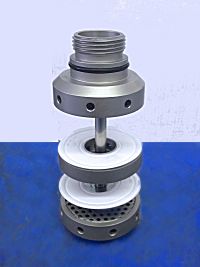
To reduce batch contamination, spoilage and product loss, effective sterile gas filtration is a necessary part of your process. Especially important in the food, beverage, and pharmaceutical industries, sterile gas filtration protects your product from harmful submicron particle contamination and bacterial transfer or growth.

MicroPure Segmented Filters feature a patented design that offers significant advantages over conventional filter cartridges.

The results are unquestionable: MicroPure Segmented Filters, designed for two-way flow, ensure consistent, uncompromised security for any application.

Mini Filter Series

If you have a small application or a small budget the Mini Filter Series might be the solution to your filtration needs. The same great quality and exceptional features at a lower cost to you.

Click here for Sterile Air Mini Filter Series information >>

Thursday, August 1, 2013

Did you know you can use an evaporator to reduce your Hazmat?


According to an easy to understand article from Poly Products,
only pure clean water is evaporated from their  EVAPORATIVE TANK™. All impurities are left behind and accumulate until the point of solution saturation. Then the solids fall out and form sludge. The sludge is scavenged out by the filter press. 


"Generators can use evaporators to reduce the volume of their hazardous waste under the generator treatment requirements. However, if there is a release of hazardous waste or hazardous waste constituent to the air or the environment, this would be considered disposal."

So as a means to reduce the amount of Hazmat you need to dispose of, by evaporating out water or other non-hazardous materials, evaporation is a great method.

Friday, July 26, 2013

Sludge Dryers - making sludge removal easy

sludge dryerSludge Dryers can be designed to handle small to large quantity sludge generators. These dryers usually fit under the filter press for direct loading. The sludge is dried by the heated liner of the unit while it is circulated by a spiral blade system breaking it up. The dryer liner can use indirect heat sources from steam, electric strips or gas fire. The preheated airflow system draws the moisture off the top of the internal dryer and out through the wet scrubber system. After drying the reduced sludge is removed by opening the discharge panel for gravity discharge into a container.

Sludge Dryer Features and Benefits       
  • sludge dryerLow cost steam, hot water or gas fire for indirect heat source or may be available with electric heat
  • 1-100 cubic feet capacities are available
  • Internal parts should be made of grade 304 stainless steel
  • Easy operation and maintenance
  • Sludge reduction savings offers an easy pay back on equipment purchase and operating costs
  • Unit dimensions may be altered to fit individual installations
  • Up to 4 to 1 reduction of sludge volume can be expected

Thursday, July 18, 2013

A Sketch of Polypropylene Textile Cloths

This is from our good friend Walter Senney, Met-Chem Group President

Although there are a lot of fibers to choose from, one of the most popular fibers used in manufacturing fabric today is polypropylene.

This versatile fiber can be woven into a variety of thread counts to allow from loose to tight filtration applications. It is good for use in temperatures from 50°F to 180°F  - Specification charts sometimes show it being use up to 250°F! However, Wally said he "would not recommend it" unless it was under specific circumstances.  Another benefit of polypropylene is it's acceptable pH can range all the way from 2- 12! Another major thumbs up  Polypropylene can be woven into a variety of cloth and cloth types allowing users to filter out the water or the baby!

Here's a little more information http://www.lamports.com/A-polypropylene.html

Or contact Lamports directly for assistance.

http://www.lamports.com/
Phone: (216) 881-2050
eMail: info@lamports.com
 

Wednesday, July 10, 2013

Keeping an organic product through an organic process

USDA guidelines state that steam used in organic processes must have 2 important features.
  • The first is that the steam is free from boiler chemicals.
  • The second is that any piping or equipment is stainless steel to ensure no rust or particles end up in the other phases of the process or the final product.
The Micropure Culinary Steam filter is made from 100% Stainless steel. The Housing, Element, Media and support structure are all made from high quality stainless steel. The media that is installed in a Micropure steam filter is absolute rated media at 3 micron. This absolute micron rating, which is below the 5 micron rated required by the 3-A culinary standard, ensures that the removal of boiler chemicals that would affect the organic process.

Monday, July 8, 2013

When your needs expand but your space doesn’t

Custom Designed Systems for Space Limitations
Is your existing equipment past its service life? Have your water demands outgrown the original equipment capacity? Do you need to
replace equipment into a congested area?
 
 
Here's a Case Study  for A major university that needed to replace their old and outdated condensate polisher used for boiler feed to keep up with demand.
 
The Problem:  Replace their old condensate polisher tank with a larger new one, with only the original footprint to work with.
 
The Process: Lakeside Water Treatment reviewed the available dimensions and facility layout and designed a custom condensate polisher system that would fit in the previous condensate polisher’s footprint and handle the increased demand.
 
The Solution:
Lakeside Water Treatment replaced the University’s old twin 36” diameter condensate polisher tank with a custom designed twin 42” diameter condensate polisher system for the boiler feed. This was able to increase the University’s output capacity while maintaining the footprint of the smaller equipment it was replacing.
 
For more information Contact Lakeside Water Treatment, Phone: 414.365.0787, or email: info@lakesidewater.com